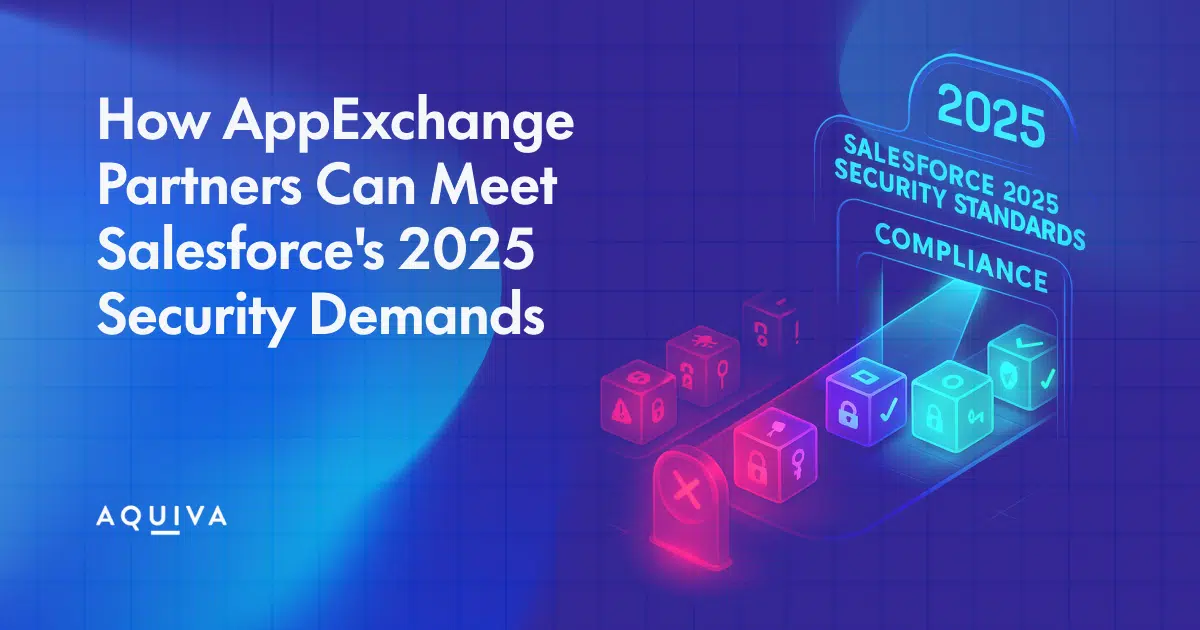
In Q4 2025, Salesforce issued a Critical Security Advisory to AppExchange partners, warning of active threats targeting both Salesforce customers and third-party applications.
This advisory was not a general security recommendation. It was a direct call to action for AppExchange partners. Salesforce emphasized that their Partner Business Organization and Packaging Organization now fall within the critical security perimeter, requiring constant vigilance over API activities.
This directive underscores the increasing importance of security within the Salesforce ecosystem, particularly for AppExchange partners who integrate various solutions and services into Salesforce.
Partners are now expected to actively monitor their API interactions to prevent potential breaches that could affect both their customers and the broader Salesforce environment.
This heightened security responsibility reflects Salesforce’s commitment to maintaining a secure, compliant, and trusted ecosystem for all users of its cloud-based applications and services.
Why Partner Business Org and Packaging Org Are High-Impact If Compromised
If you’re an Independent Software Vendor (ISV) on Salesforce, you’re likely not operating just a single Salesforce org. Instead, you’re managing a mini-ecosystem comprised of several interconnected orgs.
Within this ecosystem, two orgs, Partner Business Org (PBO) and Packaging Org, carry a disproportionate amount of risk if compromised, making them high-priority targets for cyber threats.
Partner Business Org (PBO)
Your Partner Business Org typically holds vital data related to your business and customer relationships, including:
- License Management App data, such as customer identities and the Salesforce orgs running your apps.
- CRM and support data linked to your products and customer interactions.
- Environment Hub connections to other Salesforce orgs.
If an attacker compromises your PBO, they gain access to:
- A complete map of your install base, potentially exposing all of your customers.
- The ability to execute highly targeted vishing or phishing attacks using tailored messages like, “We see you’re running version X in org Y…”
- Full access to any integrations or connected apps running from that org, allowing malicious actors to tamper with data flow or exploit vulnerabilities in connected systems.
This is why Salesforce explicitly highlights the Partner Business Org in their security advisories. If compromised, this single org can potentially offer attackers everything they need to manipulate or attack your customers, making it a critical component of your security perimeter.
Packaging Org
Your Packaging Org is where you create, test, and release your 1GP-managed packages, the building blocks of your AppExchange solutions.
A compromise here introduces significant supply-chain risks. Malicious activity could go unnoticed within what appears to be a routine package update. A breach in the Packaging Org can result in:
- Malicious code being introduced into your app updates, potentially compromising the integrity of your offerings.
- Altered integration settings or connected apps that could mislead customers or cause data leaks.
- Undermined trust in Salesforce-reviewed AppExchange apps, which could result in customers losing confidence in the safety of your products.
From Salesforce’s perspective, if your Packaging Org is flagged as compromised, the safest course of action is to temporarily treat all your apps as unsafe to protect customers, as indicated in the security advisory.
This may result in immediate disruptions to your business operations and harm your reputation within the Salesforce ecosystem.
What does it Really Mean for ISVs?
For Independent Software Vendors (ISVs), the growing importance of Salesforce security guidelines means that maintaining a secure Partner Business Org (PBO) and Packaging Org has become more crucial than ever.
Many AppExchange partners are already implementing the basics, such as multi-factor authentication (MFA), profiles, and permission sets, but the key challenge highlighted in the advisory goes beyond these foundational security measures.
Salesforce’s focus is squarely on monitoring API usage within these high-risk orgs.
In practical terms, this means that you should be able to quickly answer specific questions about API activity within your PBO and Packaging Org, such as:
- What changed?
- How does today’s API usage compare to last week’s typical pattern?
- Where did it spike?
- Which objects or time windows saw unusual activity?
- Who or what is responsible?
- Which connected app, user / integration user, or IP / geography drove the anomaly?
- Is this normal for this org?
- Is it a legitimate bulk operation, or something that has never happened before
If you can’t find the answers to those questions in just 2–3 clicks for your PBO and Packaging Org, then this call to action from Salesforce couldn’t have come at a better time.
At the same time, most partners don’t want to:
- Stand up a separate SIEM just for a couple of partner orgs
- Build a custom ETL pipeline out of event logs
- Dedicate people to “watch yet another dashboard”
To solve this, ISVs need something that’s native, lightweight, and focused on securing the PBO and Packaging Org without overcomplicating the setup.
How sAPIm Gives you the Level of Monitoring Salesforce is Asking for
This is exactly why we built sAPIm (Simple API Monitor for Salesforce), and why we are rolling it out specifically for AppExchange partners. Salesforce’s security advisory has emphasized the need for granular, real-time monitoring, especially in the Partner Business Org (PBO) and Packaging Org.
sAPIm was developed to address this precise challenge, offering a solution that simplifies API usage monitoring for these high-risk orgs.
With sAPIm, you can:
- Install a managed package directly in your Partner Business Org and Packaging Org, ensuring seamless integration without the need for complex setups or additional infrastructure.
- Turn raw API data into a simple, human-readable story, making it easier to understand critical API activities and their impact. You’ll gain insights into:
- What has changed since the last period, so you can spot variations in API usage.
- Where usage spiked, helping you pinpoint areas of concern or potential security breaches.
- Which connected app, user, or IP is behind any unusual activity, providing you with the clarity needed to track down the source of anomalies.
- See anomalies against your own baseline, not arbitrary global thresholds. This feature ensures that your monitoring reflects the specific patterns and behaviors of your AppExchange solutions without being skewed by irrelevant global metrics.
- Get concise summaries, with alerts only when something genuinely looks off. This minimizes noise and ensures that your team isn’t distracted by trivial fluctuations. The focus remains on actionable security and performance issues that truly need attention.
Importantly for many partners: If sAPIm detects suspicious activity, it automatically sends detailed notifications, providing you with the necessary context to assess and address the issue immediately.
This doesn’t require any new security platform, or team. sAPIm integrates directly into your existing workflow, providing real-time API monitoring for the two orgs Salesforce has explicitly put under the microscope: your Partner Business Org and Packaging Org.
If you’re an AppExchange partner looking for an effective, hassle-free way to meet Salesforce’s security demands, sAPIm offers the perfect solution. You can enable sAPIm in your Partner Business Org and Packaging Org to start monitoring critical API activity.
Interested in becoming a pilot customer?
Reach out to us, and sAPIm will help ensure that your Salesforce integration remains secure and compliant.
Learn more here: https://sapim.aquivalabs.com/