TDX 2026: The 5 Salesforce Announcements That Change the Rules
San Francisco, April 15–16. Moscone West. TrailblazerDX 2026.
When the Ground Shifts
I’ve been to enough Salesforce conferences to tell a product update from a change in direction. The former feels incremental, consisting of a few features, roadmaps, and demos. The latter feels like someone quietly moved the ground under your feet while you were looking the other way.
TDX 2026 was the latter.
The keynote hall at Moscone West was packed, but the crowd looked different from prior years. Fewer admins in hoodies navigating AppExchange booths. More engineers with Cursor stickers on their laptops and opinions about MCP protocols. The energy wasn’t asking how do I click less? It was asking why am I clicking at all? The entire event was framed around one word: agentic. Not as an aspiration this time. As the present tense.
Salesforce went on stage and said, plainly, that everything they’ve built over 25 years is now available as an API, an MCP tool, or a CLI command. Agents can run the entire platform. No browser required.
That is not a feature release. That is a platform identity shift.
Here are the five announcements that matter most and what each of them actually means.
1. Headless 360: The Platform Becomes Infrastructure
What happened: Every capability on Salesforce is now exposed as an API, an MCP tool, or a CLI command. Sixty-plus new MCP tools. Thirty-plus preconfigured coding skills. Agents like Claude Code, Cursor, Codex, and Windsurf can now reach directly into your org, your data, your workflows, your business logic without opening a browser. Salesforce spent two and a half years rebuilding the platform for this moment. TDX was the announcement that it’s done.
What this means for your organization
This is the do I still need an implementation partner? question dressed up as a feature release and I’ll answer it directly. The platform going headless does not reduce the need for expertise; it shifts what that expertise looks like. The hard part was never clicking around Salesforce. The hard part was knowing what to build, in what order, and with what guardrails. That doesn’t go away. It just gets delivered faster by the right people.
The practical question this raises: does your current partner have MCP and agent architecture skills, or are they still a Flow-and-declarative shop? The builder gap TDX revealed is real. Not every partner landed on the right side of it.
For ISVs: every integration you currently deliver through a Connected App or REST API should now be evaluated for MCP exposure. The products that win AgentExchange discovery will be the ones other agents can compose and invoke. That is a product roadmap decision not a future consideration.
2. AppExchange Is Dead. Long Live AgentExchange.
What happened: Salesforce didn’t announce a new marketplace. They announced the end of the old one. AppExchange, Slack Marketplace, and the Agentforce ecosystem have been merged into a single storefront called AgentExchange. Roughly 13,600 registered apps, agents, tools, and MCP servers, now searchable by business intent rather than keyword. Backed by a $50M Builders Initiative and a new GTM App with private offers, unified billing, and automated provisioning.
What this means for your organization
The unit of value in this marketplace is no longer the app. It’s the agent, the tool, the MCP server; something other systems can invoke as part of a larger workflow. If your product roadmap doesn’t include how do we become part of an agentic workflow?, it needs to. Listing as an app is no longer enough to stay visible.
For enterprise buyers, the procurement lens has to change too. You’re no longer just evaluating features and star ratings. You’re evaluating data access scope, agent behavior governance, and how a product behaves when another agent calls it at 2am without a human in the loop.
3. Agent Script Is Now Open Source. That’s the Governance Story You’ve Been Waiting For.
What happened: Agent Script, Salesforce’s language for defining how agents behave, is now GA and fully open-sourced. The spec, grammar, parser, and compiler are on GitHub. It lets you specify exactly when an agent uses LLM reasoning and when it follows deterministic logic. Subagents, guardrails, transitions, business rules are all in strongly-typed files. Salesforce also shipped the full observability suite alongside it: Testing Center, Custom Scoring Evals, Session Trace OTel API (exports to Splunk, Datadog, New Relic), and A/B Testing API.
Worth noting: Salesforce was candid that agents are probabilistic. They reason their way to unexpected outcomes. That’s not a bug. But it requires controls you can actually demonstrate to a compliance team.
What this means for your organization
If you’re in a regulated industry, this is the answer to the question your legal and compliance teams will eventually ask: how do we know what the agent will do? Agent Script lets you encode explicit business rules for high-stakes decisions while letting the LLM reason freely in lower-risk contexts. That’s not a philosophical position. It’s an auditable architecture.
For ISVs, open-sourcing the definition layer changes the competitive dynamics. Products built with Agent Script are easier to extend, audit, and certify. It’s the engineering foundation that separates professional-grade AgentExchange listings from demos. It’s also a differentiation story with your customers’ security teams. One that your competitors who skipped this step won’t be able to replicate quickly.
4. React on Salesforce. Yes, Finally.
What happened: Salesforce launched Multi-Framework, a runtime that lets developers build native Salesforce apps in React, with other frameworks coming. Open beta available today for scratch orgs and sandboxes. React apps get GraphQL record access, Apex invocations, and UI APIs with Salesforce authentication and security built in. The starter ships with Vite, Vitest, shadcn/ui, and Tailwind. This does not replace LWC. Both coexist on the platform.
What this means for your organization
Until now, building on Salesforce meant committing to its component model which created a talent ceiling. Your Salesforce UI work required Salesforce-specific engineers. Multi-Framework removes that ceiling. Experienced React developers can now contribute to Salesforce projects directly, and the same component libraries you use outside Salesforce can run inside it.
For ISVs, this is arguably the biggest developer experience shift in years. You can now build richer UIs without abandoning your engineering team’s stack. And since Agentforce Vibes generates React from natural language prompts, the prototype-to-production gap that used to consume entire PDO timelines compresses significantly.
5. Aquiva Labs Joins the Salesforce FDE Partner Network
What happened: Salesforce launched the Forward Deployed Engineering (FDE) Partner Network at TDX. A select group of firms chosen for their track record of getting Agentforce into production, not just pilots. Launch partners include Accenture, Deloitte, PwC, IBM Consulting, and Slalom. In the PDO category, Aquiva Labs was named as a launch member.
The program was built around a specific and recurring problem: most companies can build an AI proof of concept. Far fewer can take that proof of concept and make it run reliably against real data, inside complex security environments, at the operational scale the business actually needs. IDC puts the number of organizations stuck in the experimental phase at over one-third of the market. FDE partners are incentivized differently; not on hours billed, but on agents actually reaching production.
What this means for your organization
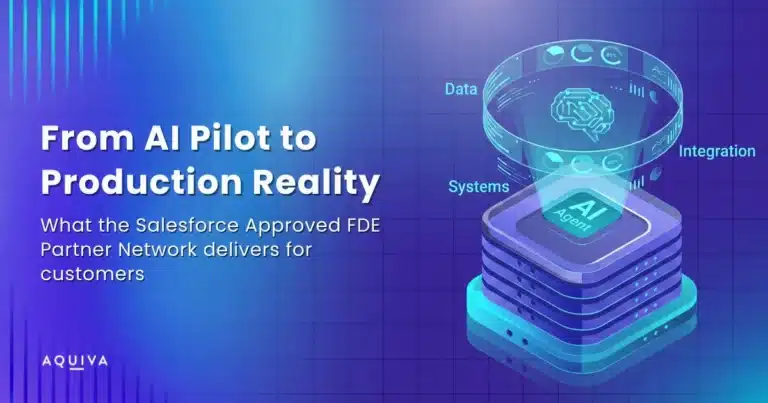
The execution gap between AI pilot and AI production is the defining challenge of this year. We wrote about this recently in From AI Pilot to Production Reality. The FDE designation is Salesforce’s answer to the question every CIO is quietly asking: which partners have actually done this, at enterprise scale, and can be trusted to do it again?
The firms on the list represent one-third of all successful Agentforce implementations to date. That’s the shortlist worth drawing from not the firm with the biggest Salesforce practice headcount.
For ISVs building for AgentExchange: the PDO dimension of the FDE network is about raising the engineering bar across the marketplace. Enterprise customers buying from AgentExchange will increasingly expect the same production-grade quality from listed products as from their FDE-delivered implementations. We hold our AppExchange work to that standard and always have.
What I’m Taking Away From TDX 2026
The companies I worry about are the ones that watched this week’s announcements and saw interesting features to evaluate. The companies that will come out ahead understood what Salesforce was actually saying: the platform is being rebuilt for a world where agents do the work, and the window to position ahead of that shift is now.
If you’re running Salesforce, the question is whether your roadmap reflects that. If you’re building on Salesforce, the question is whether your product is architected for it.
Either way, the time to answer is not after the next Dreamforce keynote.
What Does TDX 2026 Mean for Your Salesforce Roadmap?
If you want a sounding board on what TDX means for your implementation strategy or how to position your AppExchange product for AgentExchange, that’s exactly what we’re here for.
Author

Aquiva Labs
When you count on Salesforce, count on Aquiva.