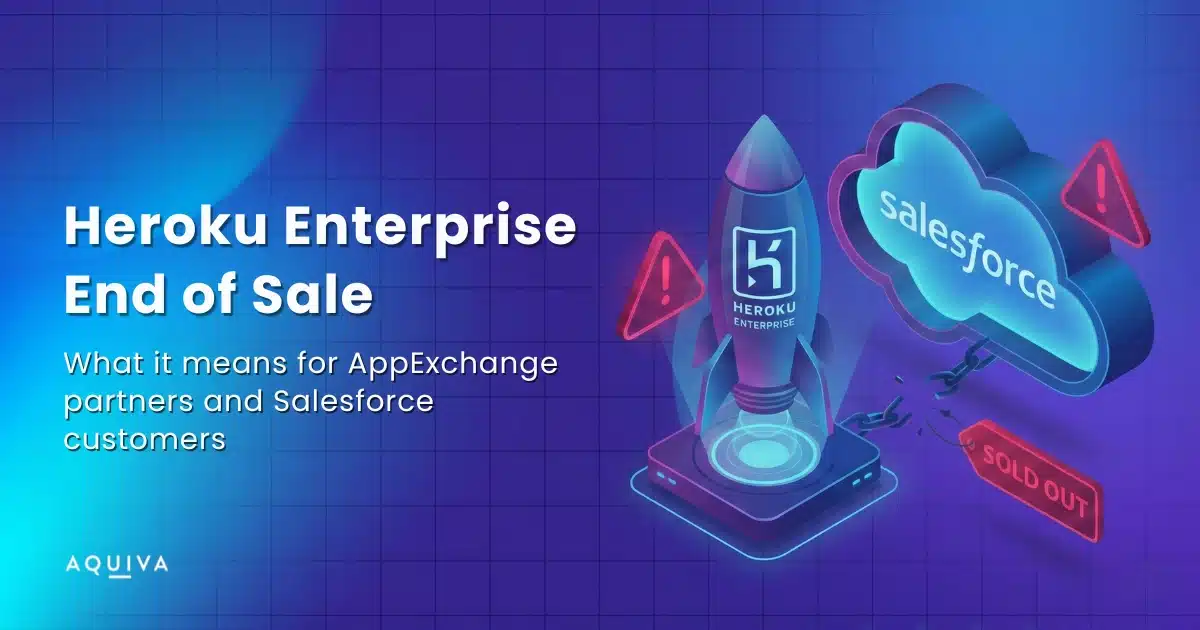
The news broke fast, as evidenced by posts like this LinkedIn update from StoreConnect CEO Mikel Lindsaar. Salesforce is shutting down Heroku Enterprise Sales. The product is now End of Sale (EOS) for net-new enterprise customers.
For many in the Salesforce ecosystem, Heroku has been far more than a convenient hosting platform. It has been the backbone of custom apps, the bridge between Salesforce CRM data and public-facing experiences, and a trusted runtime for AppExchange ISV backends. If your organization relies on Heroku in any of these capacities, this announcement deserves your immediate attention.
Let’s break down what’s actually happening, what it means for you, and how to prepare.
End of Sale vs. End of Life: An Important Distinction
Before the alarm bells get too loud, it’s worth understanding what “End of Sale” actually means, and how it differs from “End of Life.”
End of Sale (EOS) means Salesforce will no longer sell new Heroku Enterprise licenses to new customers. However, existing customers can typically continue using the product, renew their contracts, and receive support for a defined period.
End of Life (EOL) is the more definitive milestone. It means the product will no longer receive updates, patches, or official support. Eventually, it may be decommissioned entirely.
On February 6th, 2026, Heroku announced in its ‘An Update on Heroku’ post that it is transitioning to a “sustaining engineering model” and that Enterprise account contracts will no longer be offered to new customers. Salesforce has not yet announced an End of Life date but based on how past product transitions have been handled we can make reasonable projections.
When Salesforce announced End of Sale for Salesforce CPQ in March 2025, the ecosystem saw a familiar pattern: EOS first, followed by a gradual wind-down period, with End of Life estimated 4–5 years later (roughly 2029–2030 for CPQ). During that window, existing customers retained full support and could still renew licenses, but the writing was on the wall —no new investment, declining innovation, and eventual sunsetting.
We expect a similar trajectory for Heroku Enterprise. Current customers will likely be able to renew and continue using the platform for some time. But new feature development has already stagnated, and support quality will inevitably follow. The strategic direction is clear: Salesforce is moving on.
Why This Happened
Heroku was revolutionary when it launched. “Git push to deploy” changed how an entire generation of developers thought about shipping code. But over the past decade, the platform did not keep pace.
Enterprise customers found themselves locked into rigid infrastructure with limited flexibility. The rise of containerized workloads, Kubernetes, serverless architectures, and now agentic AI has fundamentally shifted what enterprises expect from a hosting platform. Customers want flexibility, reliability, and low maintenance costs. Heroku consistently delivered on only one of those three.
What This Means for AppExchange ISV Partners
If you’re an AppExchange partner using Heroku as the backend for your managed package or app, this is a critical moment. Many ISVs have built their entire infrastructure on Heroku because of its seamless Salesforce integration, particularly through Heroku Connect for bi-directional data synchronization.
Here’s what you need to consider:
Your app’s backend infrastructure is on a declining platform. Even if Heroku doesn’t shut down tomorrow, the talent supporting it is being restructured, investment is drying up, and the risk profile of depending on it grows with every passing quarter.
Heroku Connect, which many ISVs rely on for Salesforce data sync, is part of this story. While there’s no separate EOL announcement for Connect, its future is tightly coupled with the broader Heroku platform. If you’re syncing data between Heroku Postgres and Salesforce orgs, you need to start evaluating alternatives now.
Security and compliance expectations are rising. Most enterprise customers don’t just take the Salesforce AppExchange Security Review for granted — they conduct their own independent vendor and infrastructure evaluations before purchasing or renewing. Running your backend on a platform with declining support and an uncertain future could raise serious flags during those assessments. If a prospect’s security team sees your app is hosted on a sunsetting platform, that’s a risk factor that could cost you the deal.
What This Means for Salesforce Enterprise Customers
If your organization uses Heroku for custom applications, whether customer-facing portals, internal tools, or data integration layers, you should start thinking about migration planning now.
Even without an official End of Life date, the trajectory is unmistakable. Innovation has stopped. The team has been reduced. And every month you wait, the complexity and cost of migration increases.
Enterprise customers who depend on Heroku Connect for CRM data synchronization need to pay particular attention. Rebuilding that integration layer on a new platform takes planning, testing, and careful execution to avoid downtime or data loss.
Our recommendation is to treat this as a strategic infrastructure investment, not just a “lift and shift” exercise. Implement a phased approach and start with a technical assessment of your current architecture, followed by a detailed migration plan, pilot migration of non-critical applications, and finally the production cutover.
Cloud Alternatives Worth Evaluating
The good news is that the cloud infrastructure market has matured dramatically since Heroku’s heyday. There are strong alternatives, each with different strengths depending on your use case.
Amazon Web Services (AWS) remains the dominant player in cloud infrastructure. Services like Elastic Beanstalk, ECS, and Lambda offer a range of deployment models from traditional to serverless. AWS provides the most extensive ecosystem of managed services, though the trade-off is complexity. You get maximum flexibility, but you’ll need engineering resources to manage the stack.
Microsoft Azure is a strong choice for organizations already invested in the Microsoft ecosystem. Azure App Service provides a PaaS experience closer to what Heroku offered, with better enterprise integration features. Azure Functions provides serverless compute, and the platform’s integration with Active Directory and enterprise security tools is mature.
Google Cloud Platform (GCP) offers compelling options through Cloud Run and Google Kubernetes Engine (GKE). Cloud Run in particular provides a container-based deployment experience that can feel familiar to Heroku users while offering significantly more flexibility and scalability. GCP also tends to offer competitive pricing for compute-intensive workloads.
Each of these platforms can serve as a Heroku replacement, but the right choice depends entirely on your specific architecture, team capabilities, compliance requirements, and existing technology stack.
How Aquiva Labs Can Help
At Aquiva Labs, we’ve been building and maintaining AppExchange applications for years — and we have hands-on production experience with AWS, Azure, and Google Cloud as backend infrastructure for ISV apps and enterprise Salesforce integrations.
We understand this isn’t just a hosting decision. It’s an architecture decision that affects your app’s performance, security posture, Salesforce integration patterns, and long-term maintainability.
Here’s how we can support your transition:
Discovery and Advisory. Not sure which cloud platform is the right fit? We’ll assess your current Heroku architecture, evaluate your Salesforce integration requirements, and recommend the platform and architecture that best serves your specific needs. No one-size-fits-all answers — just informed guidance based on real experience across all three major clouds.
Migration Planning and Execution. Once you’ve chosen a direction, we’ll help you plan and execute the migration — from infrastructure setup and data synchronization redesign to CI/CD pipeline configuration and security hardening. We’ll work with your team to minimize disruption and ensure continuity.
Ongoing Managed Engineering. Post-migration, we can provide ongoing engineering support to keep your infrastructure running smoothly, handle scaling challenges, and ensure your Salesforce integrations remain robust as both your app and the Salesforce platform evolve.
Don’t Wait for the Official End of Life Date
If history is any guide, the official End of Life announcement will come eventually. But by the time it arrives, the best migration windows will have closed, the most experienced talent will be booked, and you’ll be making decisions under pressure rather than with a clear plan.
The sooner you start preparing, the smaller the impact on your operations. A discovery engagement today can save you months of reactive firefighting later.
If you’re an AppExchange ISV or Salesforce enterprise customer running on Heroku, let’s talk. A short conversation with our team can help you understand your options and start building a migration roadmap on your terms and timeline.
Author

Jakub Stefaniak
Field CTO, Salesforce CTA