Subcontracting is a growing trend among companies with skill shortages and hard-to-fill vacancies. In fact, 66 percent of U.S. companies with more than 50 employees outsource certain aspects of their business.
But the more links there are in your supply chain and the more parties involved, the more security risks your company may be exposed to. That’s why, for companies that leverage subcontractors, an effective supply chain risk management strategy is essential to mitigating vulnerabilities and ensuring business continuity.
We recently touched on the importance of supplier risk management in the first installment of our 3-part Risk Management blog series. In this second article, we’ll focus on subcontractors in your digital supply chain, such as developers and technology service partners, and how to manage the security risks they pose.
How Does Supplier Risk Management Work?
Effective supplier risk management begins with one key principle: you can’t secure what you can’t see.
Managing risks across subcontractors requires identifying vulnerabilities, assessing their potential impact, and building controls that reduce the likelihood of incidents.
Whether you’re outsourcing development, data processing, or system administration, every subcontractor becomes an extension of your digital ecosystem and, therefore, a potential entry point for cyber threats.
A strong Supply Chain Security Risk Management framework ensures your subcontractors are not only compliant but also technically resilient and aligned with your organization’s security posture.
Identifying Vulnerabilities Early
The first step to managing subcontractor risk is visibility. Map your entire subcontractor network, including who has access to your systems, data, and critical applications. Then, classify vendors based on their risk exposure.
Some best practices include:
- Performing due diligence before onboarding new subcontractors.
- Conducting background and compliance checks for security certifications (e.g., SOC 2, ISO 27001).
- Reviewing access permissions to ensure data minimization principles are followed.
- Establishing monitoring mechanisms for subcontractor data use and network interactions.
Early identification helps you uncover vulnerabilities before they escalate into costly breaches. It also provides a foundation for consistent oversight and governance across your vendor network.
Assessing and Mitigating Third-Party Risks
Once risks are identified, the next step is to assess their likelihood and potential impact. Every subcontractor should be evaluated using objective metrics, such as their security maturity, control frameworks, and history of incidents.
Key subcontractor management best practices include:
- Implementing continuous monitoring: Use third-party risk platforms like CyberGRX to track vendor risk posture.
- Setting clear contractual obligations: Define roles, responsibilities, and incident response expectations in your SLA.
- Running periodic audits: Conduct quarterly and annual reviews to verify subcontractor compliance and performance.
- Adopting layered risk mitigation strategies: Combine encryption, access controls, and security training to minimize exposure.
Remember, supplier risk management isn’t about eliminating every threat; it’s about managing them intelligently to maintain trust and operational resilience.
Why Is Supplier Risk Management Important?
Subcontractors are essential to many companies’ digital supply chains as they possess advanced technological capabilities that are difficult to replicate internally. But even the most qualified subcontractors come with added risk. And we’re not just talking about budget overruns and late deliveries.
Your business is responsible if a subcontractor breaches or compromises customer or member information. And when hackers attack institutions or big companies, they often target weak links, most notably subcontractors. Retail giant Target is just one of many companies that have faced this issue; they had to pay $18.5 million when a third-party data breach affected 41 million consumers.
It ensures that every external partner follows security and compliance standards aligned with your organization’s policies. When done effectively, it creates visibility across your supply chain, helping you:
- Identify weak links and potential data exposure points early.
- Enforce consistent cybersecurity and compliance standards.
- Minimize the financial and reputational impact of breaches.
- Strengthen long-term vendor relationships built on trust and accountability.
In essence, Supply Chain Security Risk Management acts as your organization’s safety net, balancing the agility of subcontracting with the assurance of data protection and compliance.
To effectively manage the risks in your supply chain, you first need to understand the difference between compliance and security, and how the two are interconnected.
Security vs. Compliance: What’s the Difference?
Third-party requirements, such as industry regulations and government policies, are the primary drivers for compliance. The goal is to establish and improve standards for goods and services throughout the commerce sector. Among the most common compliance programs are GDPR, PCI, HIPAA, and SOX. Your industry and location determine what regulations apply to your company.
Keeping up with these regulations requires consistent reporting and maintenance. Your organization may use internal and third-party resources to align internal controls with compliance program expectations. A supplier failing to follow these regulations can harm your reputation and your bottom line.
A vital part of keeping your company’s integrity intact is monitoring the legal compliance of your partners and subcontractors. At Aquiva, for example, we don’t host or process data, but we support our customers’ auditing and compliance processes, provide supportive policies, and complete questionnaires if required.
Compliance departments often need to consider the operations and controls of subcontractors as part of their audit processes. Obtaining third-party validation of “in scope” suppliers’ controls can reduce audit time and expense. You can use SOC2 and ISO27001 as control frameworks to verify the reliability of your suppliers, especially if they host or process your data.
However, ensuring your contractors are legally compliant doesn’t guarantee your company’s security. In other words, while compliance is an essential component of any risk management program—compliance doesn’t always achieve security.
Cybersecurity realities evolve much faster than compliance frameworks. For reference, GDPR’s latest version is the Data Protection Act 2018, while HIPAA’s dates back to 2013. Therefore, staying compliant isn’t necessarily enough to keep your infrastructure secure—even if compliance frameworks include a review of essential security controls and you run regular tests.
Security involves putting in place a set of technical tools, systems, and processes to protect, defend, and preserve your network, devices, and users. It’s something an organization actively works on to combat unpredictable threats to its assets. There are also no third-party standards to work toward—it needs ongoing maintenance and improvement.
Besides complying with regulations, a robust security program is crucial to strengthening an organization’s security posture and protecting its customers. Aquiva uses CyberGRX to assess our security measures and reinforce our programs with third-party tools.
On top of this, we perform regular checkups: internal security monthly; third parties quarterly; and policies and processes annually. This meticulous approach keeps our management team aware of and focused on security-related matters.
Compliance and security are important components of a supply chain risk management program, and they are both needed to maintain data security. Keeping data safe and protecting your company’s bottom requires aligning corporate compliance with internal security frameworks.
What Is the Ideal Security Framework For Your Business?
Various security frameworks exist, each with their own merits. While industry and geographical factors determine the compliance regulations you must adhere to, choosing a security framework is at your discretion.
So, how do you choose the right framework for your business?
At Aquiva, we’ve adopted and highly recommend the NIST Cybersecurity Framework.
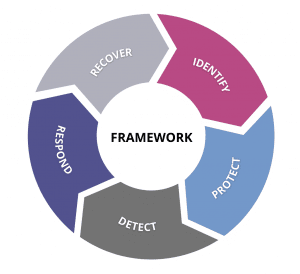
Although Aquiva doesn’t leverage subcontractors to support our clients, this framework will allow you to screen service providers and prepare for their inherent security risks. It helps you improve cybersecurity by focusing on the following five functional areas:
1. Identify
The activities in the Identify function allow you to understand your organization’s vulnerabilities, security posture, and how they relate to corporate risk. Identification is as much about understanding business context as it is a matter of inventory control.
2. Protect
By reducing the effects of threat actor behavior, hardening your assets, managing your policies, and monitoring your workloads, the Protect function allows you to proactively mitigate the impact of a potential cybersecurity threat.
3. Detect
“Assume the breach” has become a mantra among security teams. The Detect function enables the timely discovery of cybersecurity events by ensuring you have the right people, processes, and technology to respond to security events as they occur.
For other, less significant risks, you have a range of options. You may take steps to partially remove a risk, accept it, transfer it, or avoid it altogether.
4. Respond
The Respond function requires organizations to proactively develop a plan to mitigate the impact of a potential cybersecurity incident. An Incident Response Plan is essential—and so is testing this plan periodically. A security event requires clear roles and responsibilities, as well as a clear timeline and communication expectations from leadership.
5. Recover
Each breach will be different, so your recovery process will vary. But at a high level, the Recover function supports the timely recovery to normal operations, ultimately reducing the impact of a security incident. It includes removing threat actors from the overall system, keeping stakeholders informed, and mitigating reputational damage.
During the testing of their controls and as their systems evolve, we advise organizations to incorporate lessons learned and iterative updates across these five functional areas.
We also recommend NIST IR 8374 as both a practical starting point and a validation mechanism for mature security programs. It was developed in partnership with the U.S.
Department of Commerce to help businesses prepare for ransomware attacks, an increasingly common threat. It assesses an organization’s readiness to protect itself from ransomware and helps it deal with the consequences of a breach. Moreover, the framework enhances an organization’s overall security posture.
A Practical Approach to Supply Chain Risk Management
Managing security risks across subcontractors isn’t a one-time audit; it’s a continuous, data-driven process that evolves with your business and technology stack.
A proactive Supply Chain Security Risk Management strategy focuses on strengthening relationships with subcontractors through transparency, accountability, and measurable performance.
1. Strengthen Partnerships Through Proactive Frameworks
When subcontractors understand your organization’s risk management framework and are actively involved in it, they become security partners, not liabilities.
Adopting proven models like the NIST Cybersecurity Framework or ISO 27001 gives your supply chain a common language for assessing risks, responding to threats, and maintaining compliance.
By sharing metrics, policies, and updates with partners, you create a culture of shared responsibility, where every participant contributes to maintaining trust and resilience.
2. Make Risk Management Continuous and Data-Driven
Static risk assessments quickly become outdated. Cyber threats evolve, subcontractor tools change, and compliance requirements shift.
Organizations that rely on continuous risk monitoring can detect anomalies faster and respond before they escalate. Using tools such as CyberGRX or BitSight allows you to quantify and visualize third-party risk in real time.
By integrating these insights into dashboards and decision-making, businesses can shift from reactive compliance to predictive risk management.
3. Use Regular Reviews and Internal Audits to Sustain Compliance
Consistent internal reviews and subcontractor audits are key to sustaining compliance. Schedule quarterly evaluations to verify that security practices align with changing regulations like GDPR, HIPAA, or SOC 2.
These audits not only validate your partners’ reliability but also uncover operational inefficiencies that may lead to hidden risks.
At Aquiva Labs, for example, ongoing security health checks and annual framework reviews ensure that both in-house and client ecosystems maintain compliance and preparedness across evolving threat landscapes.
Conclusion: Building a Resilient and Secure Supply Chain
The rise of subcontracting has made digital ecosystems more agile, but also more exposed.
Organizations that treat Subcontractor Risk Management as a strategic function, not a compliance checkbox, are the ones best positioned to protect data, maintain trust, and ensure operational continuity.
By integrating a strong Supply Chain Security Risk Management framework, prioritizing both compliance and security, and maintaining ongoing visibility into subcontractor activities, your business can minimize disruptions and safeguard customer confidence.
At Aquiva Labs, we help organizations identify, assess, and mitigate third-party risks using proven frameworks and modern security practices. Whether you’re looking to strengthen your compliance posture, evaluate your subcontractor ecosystem, or build an adaptive risk management strategy, our experts can help you do it confidently and securely.
Ready to take the next step?
Contact Aquiva Labs to learn how we can help you build a more secure, compliant, and resilient supply chain.
FAQs on Managing Security Risks in Subcontracting and Supply Chains
Subcontractor risk management is the process of identifying, assessing, and mitigating risks that arise when third parties or subcontractors handle critical business operations, data, or systems. It helps ensure business continuity, compliance with regulations, and protection against cybersecurity threats throughout the supply chain.
Subcontractors often have access to sensitive systems and data. If their security controls are weak, attackers can exploit them as an entry point into your organization. Strengthening supply chain security risk management ensures that every partner maintains adequate protection, reducing the risk of breaches and regulatory violations.
Compliance focuses on meeting legal and regulatory requirements such as GDPR, HIPAA, or SOC 2, while security involves implementing technical safeguards like encryption, monitoring, and access control. Both are essential; compliance builds trust, and security ensures ongoing protection from evolving cyber threats.
Organizations can assess subcontractor cybersecurity by using standardized frameworks like the NIST Cybersecurity Framework, ISO 27001, or third-party evaluation platforms such as CyberGRX. These tools help evaluate subcontractors’ controls, detect vulnerabilities, and ensure alignment with your organization’s risk management standards.
- Conduct due diligence before onboarding subcontractors.
- Include cybersecurity and compliance clauses in contracts.
- Perform regular audits and risk assessments.
- Require adherence to frameworks such as NIST or ISO.
- Continuously monitor for changes in subcontractor operations or tools.