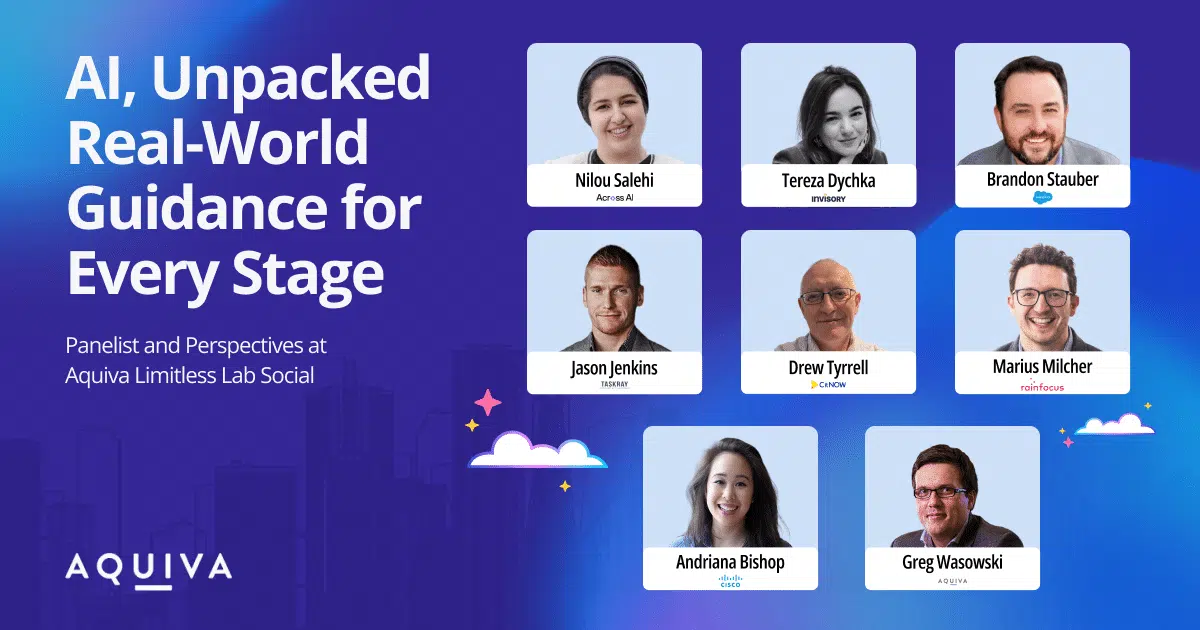
Based on our Dreamforce panel: AI, Unpacked: Real-world Guidance for Every Stage.
Every technology wave promises reinvention. Few deliver it. The agentic enterprise may prove an exception – not because of its novelty, but because it redefines what work itself means. Marc Benioff called AI agents “the beginning of an unlimited workforce.” That framing captures both the promise and the peril of what comes next.
As Nilou Salehi, CEO of Across.ai and Associate Professor at UC Berkeley, put it, “it’s 50 per cent a technical problem and 50 per cent a human one. Most of the time deployments fail because they forget the human part entirely.”
At its simplest, the agentic enterprise is one where human employees and autonomous AI agents operate in tandem, reasoning, acting, and learning in pursuit of business outcomes. But what sets it apart from automation is intent. These agents are not mechanical extensions of workflow scripts; they make decisions, adapt to context, and collaborate.
As McKinsey observed in its 2025 review of early adopters, “the most successful teams aren’t building tools; they’re teaching agents how to think within guardrails.”
That distinction matters.
The shift from static automation to adaptive agency introduces a new set of governance, cultural, and architectural challenges. And it is here, not in the technology, that the enterprise divide is emerging. This article draws on insights from the panel I moderated at Dreamforce ‘AI, Unpacked — Real-World Guidance for Every Stage’, where senior leaders from Salesforce, Cisco, RainFocus, TaskRay, Across.ai, Invisory and CitNOW shared what is actually working in enterprise AI adoption today.
From Automation to Autonomy
Agentic enterprise is the next evolution of operating models – a structure built not on workflows but on networks of intelligent, goal-oriented agents. In this vision, AI doesn’t just optimise a task; it reasons toward an objective. This capacity transforms business functions from sales to finance, replacing rote processes with adaptive collaboration between systems and people.
In practical terms, agentic AI already handles high-volume, low-variance work. A Salesforce support agent can triage thousands of requests a week, while a marketing agent can score and route leads in real time.
Yet these examples, impressive as they are, obscure the deeper shift.
In the agentic enterprise, the human role becomes orchestration. Employees no longer perform the task; they supervise the system that performs it. “AI will change the org chart; new roles will emerge for people managing the agents themselves,” summed up Nilou Salehi.
The Rise of the Agentic Layer
Traditional assistants were narrow and reactive. Agentic AI links reasoning with action.
Salesforce’s Agentforce represents that shift. Rather than simply generating text, it generates actions: updating opportunities, sending approvals, or triggering integrations. This evolution changes not only how AI works but how teams interact with it. As AI takes on execution, the question becomes how far it should go on its own, and where human oversight still matters.
Brandon Stauber, Director Partner Solutions – Technology Strategy & Solutions at Salesforce, explained: “The conversation is not about removing humans from the loop; it is about deciding when they should be there. Gartner called it the ‘guardian agent’ model, and I think that is the right lens: observability first, then autonomy.”
Success, he added, depends less on model capability than on foundation quality.
Agentic systems require clean, connected data, clear process logic, and visible governance. Without those, AI can only suggest, not do. CRM provides the structure that gives AI both context and constraint, the two elements that make autonomy safe and useful.
As Brandon Stauber noted during the session, “the challenge isn’t building smarter models, it’s deciding when and how to let them act. Autonomy without guardrails isn’t innovation; it’s instability.”
Tereza Dychka of Invisory described it as a maturity curve: “Most companies aren’t struggling with the technology; they’re learning how to build trust around it.”
Making Systems Agent-Ready
Building an agentic enterprise starts with data. AI cannot act where information is inconsistent or hidden behind manual steps. The first move is to harmonise data models across clouds so that customer, product, and case data form a single view.
Drew Tyrrell, Director of Strategy at CitNOW Group, put it simply:
“What has become clear in the last few months is that data quality, not just data access, is the real foundation. You cannot have an agentic enterprise without trustworthy data to act on.”
Jason Jenkins, SVP of Sales and Customer Success at TaskRay added:
“Do most organisations have the plumbing to take advantage of AI? Quick answer: no. Last year has been about platforming the data silos that exist inside businesses. (…) AI’s success is proportional to the quality of data access. Once you smooth that out, you start to see value almost immediately.”
Processes come next.
In most organisations, automation is fragmented across flows, APIs, and approvals. To make AI a participant, those processes must be explicit and logical. That means expressing business rules declaratively, mapping decision points through metadata, and documenting compliance conditions. The clearer the structure, the safer it is for AI to act within it.
Security and auditability complete the picture. Every AI action must be traceable: who initiated it, what it did, and why.
“Trust is not a feeling, it is an architectural outcome,” said Brandon Stauber from Salesforce.
“Observability, audit trails, explainability, that is how you scale confidence.”
In regulated sectors such as finance and healthcare, those controls make adoption possible at scale.
Lessons from the Front Line
The practical reality of agentic systems is emerging in live environments, not in theory. The panellists in AI, Unpacked described what success looks like when AI operates safely within Salesforce.
Drew Tyrrell of CitNOW described the operational complexity holding many industries back.
“In automotive, it takes more than a dozen disconnected systems to sell a single car,” he said. “With turnover above 50% in dealerships, each system becomes a training problem. Wrapping that complexity in guided, agentic workflows is where the real ROI lies.”
His example showed that fragmentation remains the first obstacle to automation.
Nilou Salehi argued that progress often starts with simplicity: “Some of the biggest surprises in early AI deployments were not the complex automations, they were the simple wins. Cleaning up duplicate contacts, fixing data inconsistencies, reducing friction. Those small, unglamorous fixes deliver the fastest return.”
She added, “Some of the earliest wins we have seen are simple but compounding, shaving a few minutes off each customer interaction, reducing errors, freeing teams for higher-value work. Those small efficiencies add up fast.”
Andriana Bishop, Sr. Director of AI Strategy at Cisco’s Automation & AI Centre, linked adoption to transparency: “Explainability drives trust, and trust drives adoption. You cannot separate the two, if people cannot see how AI reached a decision, they will not use it.”
Marius Milcher, VP Platform Strategy and AI at RainFocus, pointed to organisational challenges: “The biggest friction we hit is still integration, signals trapped in separate systems. The technology exists to fix it, but human process and ownership are the harder parts.”
Jason Jenkins summed up what ties it all together: “We used to think AI’s biggest gains would come from deep automations, but the real impact came from cleaning up the basics, the data, the flows, the user experience. Once you do that, everything else accelerates.”
Nilous Salehi, reflected on organisational design: “We mapped out all the things a person would do and matched them to what the AI should do. Step zero is understanding the job to be done. (…) Human-centred AI isn’t new; we’ve just forgotten the lessons from human–computer interaction.”
Across industries, the message was consistent: strong data, clear processes, and deliberate trust-building underpin every successful agentic project.
The Road Ahead
The next phase of AI adoption will belong to enterprises that treat autonomy as an outcome of governance, not an experiment in automation. “The future is not fully autonomous, it is governed, auditable, and deeply human in design,” said Brandon Stauber.
“Automation at scale will soon be outdated because we’ll all have reached it. The next wave is insight — AI that reveals what we should do next,” added Andriana Bishop.
For companies building on Salesforce, the approach is clear: clean the data, document the process, enforce governance, and let AI handle the repeatable work. The agentic enterprise is not hypothetical. It is emerging now, built on discipline, not hype.
Tereza Dychka from Invisory closed the discussion with practical advice. “Start small, iterate quickly, and work with partners who are ready to deal with both the failures and the gains. Trust is built in production, not in PowerPoint.”
At Aquiva Labs, that intersection is where we work every day. In the agentic era, the most valuable systems will not just store information; they will act on it.
The future of the agentic enterprise will not be written by those who move fastest, but by those who move with precision. Governance, architecture, and trust are not side constraints; they are the core enablers. Friction will persist until there is confidence and control for executives, speed and reuse for teams, and measurable ROI for the enterprise.
That may be the real lesson of this era: the agentic enterprise is not a technical revolution. It is an organisational one. The winners will not be those with the most agents, but those who know exactly what each one is for.